Hello Lucky Font: A Cheerful Retro Display Typeface for Crafters
If you've ever spent hours hunting for a font that feels joyful but still holds up on a physical product—whether it's a hand-stamped candle label, a vinyl-cut welcome sign, or a printed wedding menu—you know how rare it is to find one that’s both expressive and production-ready. Hello Lucky is that font. It’s not just playful; it’s purpose-built for makers who need charm without compromise.
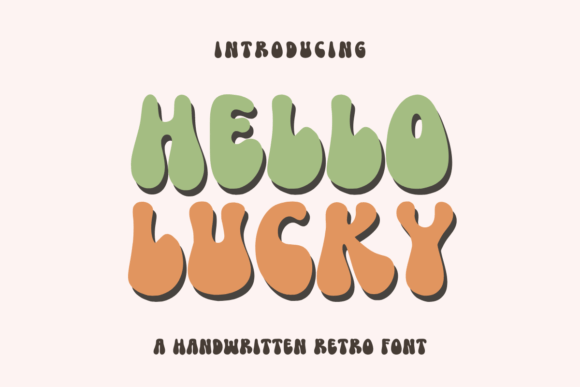
Visually, Hello Lucky lands somewhere between mid-century diner signage and vintage greeting cards—rounded letterforms, gentle contrast, a subtle bounce in the baseline, and that unmistakable retro warmth. It’s not overly ornate, so it cuts cleanly on Cricut and Silhouette machines. And because it’s designed as a display font, it shines brightest where attention matters most: headlines, titles, quotes, and short impactful phrases.
Where Hello Lucky Fits in Your Physical Product Workflow
This isn’t a body text font—and it shouldn’t be. Hello Lucky thrives in moments of emphasis. Think of it as your visual “hello” to customers: the first thing they see on a boutique gift tag, the bold title on a printable planner cover, or the cheerful phrase stamped onto a linen tea towel. Its rhythm and spacing are tuned for legibility at medium to large sizes—even when scaled down to 18–24pt on small product labels or sticker sheets, it retains its personality without blurring or losing clarity.
For handmade sellers, Hello Lucky works especially well on:
- Candle and soap labels — pair it with a clean sans serif for ingredient lists, and let Hello Lucky carry your brand name or scent title (“Lucky Clover,” “Golden Hour,” “Rainbow Sprinkle”)
- Wedding stationery — use it for “Welcome,” “Mr. & Mrs.,” or table numbers on acrylic signs or foil-printed menus
- Seasonal packaging — it’s a natural fit for St. Patrick’s Day (think “Luck of the Draw” on cookie boxes or “Shamrock & Co.” on reusable produce bags), but also Easter baskets, birthday party favors, and summer farmers’ market tags
- Tote bags and tees — its friendly weight and open counters mean it prints crisply in screen printing, DTG, and heat transfer vinyl
- Digital printables — whether you're selling editable Canva templates or layered SVG files for crafters, Hello Lucky adds instant personality to quote posters, habit trackers, and wall art bundles
Readability Tips You’ll Actually Use
When cutting Hello Lucky from vinyl or cardstock, avoid using it below 14pt for intricate details—especially if your design includes tight curves or fine interior spaces (like the counter of the lowercase a or e). For small stickers or jar tags under 2 inches wide, stick to uppercase-only phrases or simplified words (“LUCKY,” “HELLO,” “YES!”) — the font’s alternates and ligatures help here, too, if included.
In mockups and digital previews, always test Hello Lucky against your background color. Its rounded forms can soften on low-contrast combinations (e.g., light gray on white), so consider adding a subtle stroke or shadow when previewing for Etsy listings or social media graphics.
Smart Pairings That Elevate Your Designs
Hello Lucky sings when paired intentionally—not just for contrast, but for cohesion. Try these combos in your next project:
- A soft handwritten font (like a relaxed script) for names or personal notes, with Hello Lucky anchoring the headline — ideal for baby announcements or custom greeting cards
- A crisp, neutral sans serif font (think Montserrat Light or Inter Regular) for body copy, pricing, or care instructions — keeps packaging professional while letting Hello Lucky bring the joy
- A warm, low-contrast serif font (like Playfair Display or Cormorant Garamond) for elegant balance — perfect for wedding welcome boards or boutique apothecary labels
The key is contrast with intention: Hello Lucky brings energy, so your pairing should ground it—not compete with it.
Licensing, Formats, and Real-World Practicality
Before adding Hello Lucky to your shop’s design toolkit, double-check the license. Most reputable commercial fonts allow use in physical products, digital downloads, and client work—but restrictions vary. Look for explicit permission to use in SVG files, editable templates, and merchandise (like mugs or shirts). If Hello Lucky includes OpenType features like stylistic alternates or swashes, those are bonuses for creating variation across your product line without buying multiple fonts.
File format matters, too. Make sure you’re getting .OTF or .TTF files—not just web fonts—for full compatibility with design software (Cricut Design Space, Silhouette Studio, Affinity Designer, Adobe Illustrator) and cutting machines. Bonus points if it supports extended Latin characters—helpful for international buyers or multilingual holiday tags.
Why Hello Lucky Builds Brand Trust—Not Just Visual Appeal
Customers don’t just buy products—they buy feelings. Hello Lucky communicates approachability, nostalgia, and sincerity. When someone sees it on your handmade lavender sachet label or your printable gratitude journal cover, it quietly signals that your brand values thoughtfulness and craftsmanship—not just speed or scale.
That emotional resonance translates directly to repeat sales and word-of-mouth. A consistent use of Hello Lucky across your Etsy shop banners, product photos, and downloadable templates builds recognition. Over time, customers start associating that cheerful bounce with your shop—just like they’d recognize a signature color or illustration style.
And because it’s a premium display font, it helps your listings stand out in crowded search results. “Hello Lucky font” may be a niche query—but crafters searching for “retro font for stickers” or “cheerful font for printable wall art” will land on your shop faster when your designs showcase intentional, high-quality typography.
So whether you're designing your first batch of holiday gift tags or building a full branding suite for your small-batch candle line, Hello Lucky isn’t just another typeface—it’s a reliable, joyful, production-smart tool you’ll reach for again and again.